
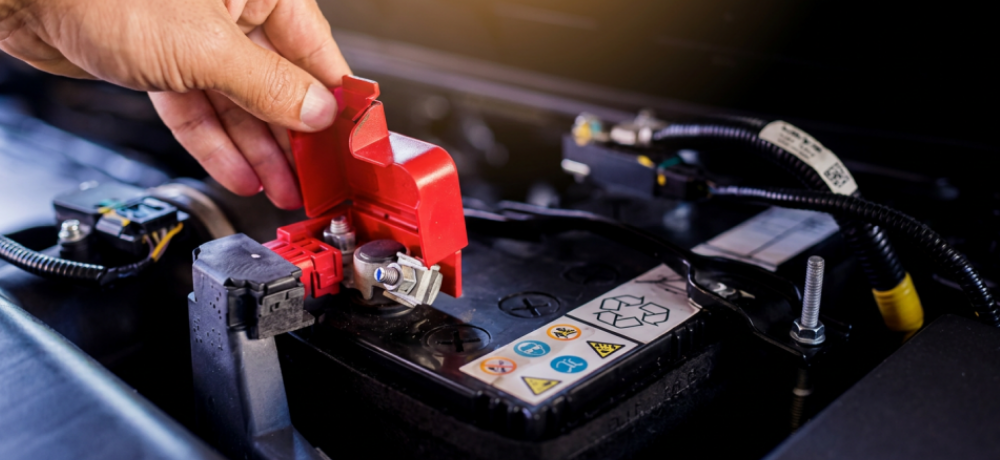
Engineering discussions about electric vehicles (EVs) often center on performance, range, charging speed, and the demanding environments these vehicles must withstand. However, an often-overlooked aspect of EV reliability is how these vehicles behave when they are turned off. Even while powered down, connected electronics continue to draw power from the auxiliary 12V system. Over time, this parasitic power draw can leave the vehicle with a depleted 12V battery, making it unusable, even though the vehicle’s main or traction battery is charged.
Compared to internal combustion engine (ICE) vehicles, EVs place significantly higher demands on their auxiliary 12V systems, which include additional electronics to monitor the battery system and the charging port even while off. Many auxiliary battery failures stem from a fundamental misunderstanding of this off-state energy behavior and the hidden reliability risks associated with parasitic electrical loads. In the following sections, we’ll explore why these challenges occur, where they’re often overlooked, and how integrated charging solutions help address them.
Why EVs Are More Vulnerable to 12V Battery Drain
Electrical components in both EVs and ICE vehicles do not fully power down when the vehicle is turned off. Components such as electronic locks, key fob receivers, clocks, radios, communication modules, alarm systems, and immobilizers continue drawing small amounts of power from the auxiliary 12V battery. EVs can introduce additional off-state loads, including motor controllers, battery chargers, charge-port sensing, and EVSE monitoring, which further increase background power draw.
This continuous energy consumption, known as parasitic power drain or parasitic loss, gradually depletes the auxiliary 12V battery. Although parasitic drain affects both EVs and ICE vehicles, it does not impact them equally. The parasitic drain exhibited by typical ICE vehicles often goes unnoticed because the vehicle’s auxiliary 12V battery may take months to deplete. In EVs, higher parasitic drains can cause the 12V battery to reach critically low charge levels within weeks.
The Industry’s Blind Spots—OEMs and End Users
OEMs progressing through early electrification phases may underestimate the importance of managing auxiliary 12V parasitic drain. It is often assumed that EVs exhibit the same off-state behavior as ICE platforms, creating a gap between design assumptions and real-world system performance.
This misunderstanding of the 12V auxiliary system can continue to be overlooked as OEMs pursue greater power output, longer range, faster charging, and more application-specific features, increasing the complexity of the vehicle’s electrical architecture. In many conventional EV architectures, OEMs separately source the on-board charger, DC-DC converter, and charge port controller that interfaces with the EVSE. These separate components can create system fragmentation, leading to longer integration timelines, higher costs, and greater potential for reliability issues as OEMs scale.
When the impact of the 12V system parasitic draw is not identified until later in development, OEMs are often left with bolt-on solutions that force difficult trade-offs. Some OEMs try installing a larger auxiliary battery to compensate, but this adds cost and additional maintenance challenges. Others rely on a standard DC-DC converter, but without customization, it may only operate when the vehicle is powered on, leaving the 12V battery unmanaged and unable to be recharged during critical and potentially long off periods.
Consequences Felt by End Users
Whether caused by increased parasitic drain, incorrect assumptions about off-state 12V energy use, complex integration issues, or inadequate charge management, auxiliary 12V battery depletion can become a predictable outcome in many EVs if the issue is not addressed at the system level. The risk is especially pronounced when vehicles spend extended periods powered down, sitting in inventory, or parked in rental yards between uses.
The most immediate impact is a vehicle that will not start, reducing operational uptime and creating service disruptions. This is especially critical in commercial and industrial applications, where companies rely on electric vehicles and equipment to be available when needed.
Over time, frequent or prolonged deep discharges shorten battery life, leading to premature failures, higher service costs, and increased vehicle downtime. Cold weather compounds the problem by reducing available 12V battery capacity, causing depleted batteries to appear more frequently and after shorter vehicle off periods. Under these conditions, an auxiliary battery expected to last three to five years may require replacement annually.
Intelligent Charging as a Solution
Rather than performing complex integration with components from multiple suppliers, OEMs can simplify development by using a single solution that combines main battery charging, auxiliary battery charging, DC-DC conversion, and charge port control. Delta-Q’s integrated charging solution brings these core functions together, reducing system complexity while enabling more reliable management of the auxiliary 12V battery.
Embedded into this solution is LifeCharge, Delta-Q’s battery intelligence for auxiliary battery monitoring and charging. LifeCharge enables our integrated charging solution to monitor, recharge, and maintain the 12V system and 12V battery across all vehicle states. It supplies power to the 12V system and autonomously recharges and maintains the 12V battery without direction from the vehicle control unit or vehicle operator.
LifeCharge supports the vehicle’s 12V system in every operating state. It powers 12V loads from the traction battery during operation, converts AC power to maintain the 12V system while charging, and automatically monitors and recharges the 12V battery whenever the vehicle is inactive.
Together, these functions ensure that the 12V battery remains charged and the vehicle remains ready to use.
This intelligent maintenance capability continues even during extended periods of inactivity. LifeCharge draws a small amount of energy from the main traction battery to monitor, recharge, and maintain the auxiliary 12V battery, offsetting the effect of parasitic drain. Depending on parasitic draw and traction battery capacity, this maintenance typically consumes approximately 1% of the main traction battery charge per month. At that rate, it would take more than eight years of continuous vehicle inactivity to fully deplete both batteries, making complete discharge highly unlikely in normal use.
How LifeCharge Operates Across Vehicle States
LifeCharge operates differently depending on the vehicle state:
- Turned Off – Autonomously monitors auxiliary battery voltage and initiates recharging when detecting levels below minimum thresholds. The system uses absorption and float charging to maintain battery health without user intervention.
- Startup – Boosted output voltage to ensure the 12V system has reliable power during vehicle startup, when many electrical components can have larger power consumption.
- Driving – Maintains an optimized float voltage to ensure stable system power while minimizing battery stress and degradation.
- AC Charging – Sustains battery float while the vehicle is plugged in, supporting active system loads while maintaining state of charge.
- Adaptive Charging Logic – Uses intelligent voltage thresholds and periodic monitoring to trigger charging only when required, reducing unnecessary cycling and extending battery life.
With Delta-Q’s integrated charging solution, LifeCharge counteracts parasitic battery drain in EVs by autonomously recharging and maintaining the auxiliary 12V battery. As a result, off-state energy use becomes a negligible factor, helping extend battery life and keep vehicles operationally ready, even after prolonged periods of inactivity.
Validated for Real-World Performance
LifeCharge has been validated through laboratory testing, real-world field trials, and customer deployments. Built on Delta-Q’s decades of product design and battery charging expertise, the solution delivers reliable performance across a wide range of real-world operating conditions.
For OEMs, the pre-integrated architecture simplifies system integration by reducing the number of separate components, connectors, and wiring required. For end-users, it ensures vehicles remain ready to operate after extended periods of inactivity while reducing maintenance associated with premature auxiliary battery failures.
As EV platforms become increasingly connected and electrically complex, managing the auxiliary 12V battery is no longer a secondary consideration—it is now a fundamental part of vehicle readiness and long-term reliability. Designing for off-state operation from the outset helps avoid compromises later in development while ensuring vehicles remain ready to operate, regardless of how long they remain inactive. Ultimately, the most effective innovations are those that operate invisibly, preventing failures before they occur.
To learn how Delta-Q’s integrated charging solutions with LifeCharge can support your EV platform, contact Delta-Q to discuss your application requirements.