ZAPI GROUP’s 2026 Future of Electrification (FOE) Virtual Conference made one thing clear: discussions around electrification have moved beyond whether electric platforms are possible. The focus is now on what it takes to make them scalable, reliable, cost-effective, and ready for real-world applications.
Across more than 22 expert-led sessions and panels, Delta-Q Technologies (Delta-Q) and its battery partners contributed frontline perspectives on charging technology, system integration, and real-world deployment challenges.
Here are five strategic insights from FOE 2026 shaping the future of batteries, charging, and electrification.
Insight 1: Battery technology is maturing, but system integration is now the bigger challenge

Battery technology is no longer the primary bottleneck limiting the progress of electrification. While OEMs were previously constrained by whether the right technologies were available or mature enough, today’s challenge is different: selecting and integrating the right battery solution for the specific application.
This theme came through in FOE’s “The Realities of Battery Technology in Modern Electrification” panel discussion moderated by Becky Schultz, Vice President of Content for KHL Power Group. The panel featured Davide Dal Pozzo of Aliant Battery/ELSA Solutions SpA, Alexandre Meyer of Foresee Power, Lucia Salcido of Flux Power, and Joe DeCarlo of Panasonic Energy, who discussed how battery selection is evolving from a technology availability question to a system-level integration challenge.
Dal Pozzo opened the conversation with an overview of improvements in energy density and the expansion of custom capabilities, such as battery shapes and voltages. These advancements show how far battery technology has progressed, shifting the focus from disruption to chemistry optimization. The panelists also emphasized that the biggest performance and efficiency gains moving forward will come from stronger system integration.
DeCarlo noted that batteries are often blamed for failures when the real causes are integration, placement, and underestimating real-world duty cycles. Partial charges, temperature fluctuations, long idles, and other factors often contribute to harsher conditions than expected during the design stage. Salcido added that real-world data visibility has improved significantly, but analysis and actionable alerts can remain challenging. Now that integrated systems collect so much data, OEMs need to simplify, leverage, and connect that information through dashboards and AI-driven analysis.
As DeCarlo summed up, “everyone wants to chase shiny toys, but developing the best and most scalable system is more important than choosing the best battery as an individual component.”
Insight 2: Sodium-ion is the next big shift in material handling battery & charging systems
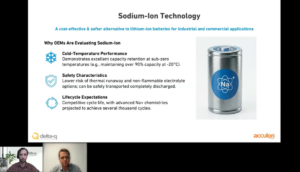
Sodium-ion battery technology is gaining attention as OEMs look for chemistries that better match specific application needs, particularly in environments where safety, cold-temperature performance, fast charging, and durability are critical. When paired with validated charging systems, sodium-ion can provide a robust and safe power platform for targeted applications.
This theme was explored in the “Sodium-Ion: The Next Big Shift in Material Handling Battery & Charging Systems” session, led by Andrew Thomas, Co-Founder and President at Acculon Energy, and Jamie Tolliday, Sales Application Engineer at Delta-Q Technologies.
Comparing the cost-effectiveness and safety of sodium-ion to lithium-ion chemistries, Thomas and Tolliday highlighted several differences, including cold-temperature performance, non-flammable electrolyte, low thermal runaway risk, longer battery lifespan, and the ability to fully discharge without significant degradation. They also noted that some sodium-ion chemistries now outperform lithium iron phosphate (LFP), causing new adoption and switching challenges. However, battery-charger validation remains crucial to achieving this level of performance.
Material handling stood out as a strong early-fit market for sodium-ion, with applications ranging from cold storage equipment to robotics. Its low-temperature resilience can offer better performance than lithium or lead-acid batteries in cold storage environments, while its fast-charging capabilities support high-use duty cycles. This makes sodium-ion especially relevant for applications such as autonomous mobile robots (AMRs) and automated guided vehicles (AGVs), where predictable operation, fast charging, and safety are critical. Thomas noted that Acculon’s sodium-ion battery can reach full charge in around 25 minutes.
As sodium-ion technology matures, 2026 could be a significant year for adoption in targeted applications rather than as a universal replacement. For OEMs, the opportunity is in understanding where it fits best and ensuring it is paired with the right charging strategy and validation process.
Insight 3: Battery data becomes valuable when it drives real-time action
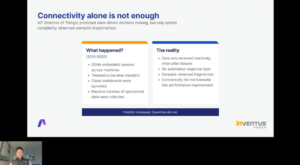
Connectivity can unlock substantial business value across electric fleets when data moves beyond collection and into action. In their FOE 2026 session, Tom Nguyen, Vice President of Business Development and Product Strategy at Inventus Power, and Nick Gunady, CEO at Aerovy, demonstrated how data transfer between batteries, integrated systems, cloud-based architecture, and AI-driven analysis can support rapid over-the-air updates and turn battery data into real-time operational insight.
Electrification is making connectivity more valuable because electric platforms can collect more raw data from motor controllers, batteries, and other integrated systems than internal combustion engine platforms. This creates more opportunities to monitor performance, identify issues earlier, and inform operations in real time.
Still, connectivity alone is not enough for OEMs to become market leaders. Looking at the proliferation of IoT devices from 2015 to 2020, Nguyen and Gunady noted that many OEMs added sensors, standardized telematics, launched cloud dashboards, and collected massive volumes of data. In many cases, though, poor implementation only added complexity. Operations teams still often view data reactively after failures occur or lack an automated response layer. With so many datasets fragmented, connectivity by itself does not always translate into performance improvements.
Nguyen and Gunady have seen OEMs achieve better performance and greater ROI by creating a “closed loop” for analysis and updates. By automating processes, flagging anomalies, and delivering patches before issues escalate, this approach helps improve reliability, create more consistent fleet behavior, and support continuous improvement in real time.
Insight 4: Electrification is shifting from a sustainability story to a cost and execution story

Panelists Sarah McKinnon (CEO at Delta-Q Technologies) and Claes Avasjo (Executive Director at ZAPI GROUP) joined Sara Jensen (Executive Editor at Power & Motion) for a deep dive into the complexities of the global electrification landscape. As economic pressures, customer expectations, regulations, and market conditions vary by region, leadership, strategy, and execution will play a larger role in determining where electrification gains traction.
Both McKinnon and Avasjo repeatedly emphasized that, while regulations and sustainability concerns have driven previous electrification efforts, the primary driver today remains cost analysis. Put simply, the total cost of ownership of an electric platform can yield meaningful cost savings for operators compared to ICE alternatives, particularly as oil prices increase by 50%.
Further breaking down the landscape into traditional and emerging markets for electrification, McKinnon stated that applications electrified decades ago still show steady growth, but newer markets can be more complex. She expects dynamic change in new markets, where recent geopolitical and economic uncertainty might dampen enthusiasm for certain applications, while breakthroughs in automation and robotics already generate more hype for others. Regardless of these fluctuations, companies in the electrification space, like Delta-Q Technologies, will continue investing.
Avasjo also covered how regional factors, such as regulations, infrastructure, energy economics, and customer demand, can shape global electrification rates. For example, China’s faster efforts are state-driven, Europe’s slower pace is regulatory-driven, and North America is a patchwork of both with additional incentive structures. Adding to Avasjo’s explanation, McKinnon explored this dynamic through cost pressures in established markets (such as components and systems or total ownership costs), noting that new entrants and Chinese OEMs help force competitors to innovate and keep costs down.
Insight 5: High-voltage charging is expanding what electrification can realistically support
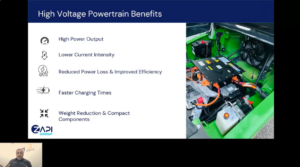
With the emergence of high-power, high-voltage (HV) powertrains enabling the electrification of new applications, Mourad Chergui, Senior Product Manager at Delta-Q Technologies, explained how charging technology is evolving to support the next generation of electrified machines. Developing solutions for applications like large construction or agricultural equipment (which have previously been too difficult to electrify) is now increasingly possible via HV platforms.
After providing an overview of 60V and 120V low-voltage systems and 400V and 800V high-voltage systems, Chergui highlighted the increased presence of large electrified machinery at industry events in recent years. For example, Agritechnica 2025 exhibited 29 vehicles, and the percentage of HV models at ConExpo more than doubled from 2020 to 2026.
Chergui broke down the tradeoffs of HV platforms as follows:
| HV Benefits | HV Hurdles |
|
|
Looking closer at different HV powertrains, 400V (or 650V) is the voltage currently preferred for electrifying compact to mid-size mobile machinery, and it’s well established. The emerging 800V architecture will provide the ultimate performance for electrifying heavy mobile equipment.
With the rapid progression of components and technologies that support HV powertrain architectures, Chergui anticipates seeing a proliferation over the next three to four years.
View Future of Electrification 2026 Recordings for More Insights
The strongest takeaway from FOE 2026 was that electrification success does not come from adopting one technology in isolation. It comes from building complete systems that are validated, connected, cost-effective, and designed around how machines actually operate.
To explore more insights from FOE 2026, watch the full session recordings on ZAPI GROUP’s YouTube channel.